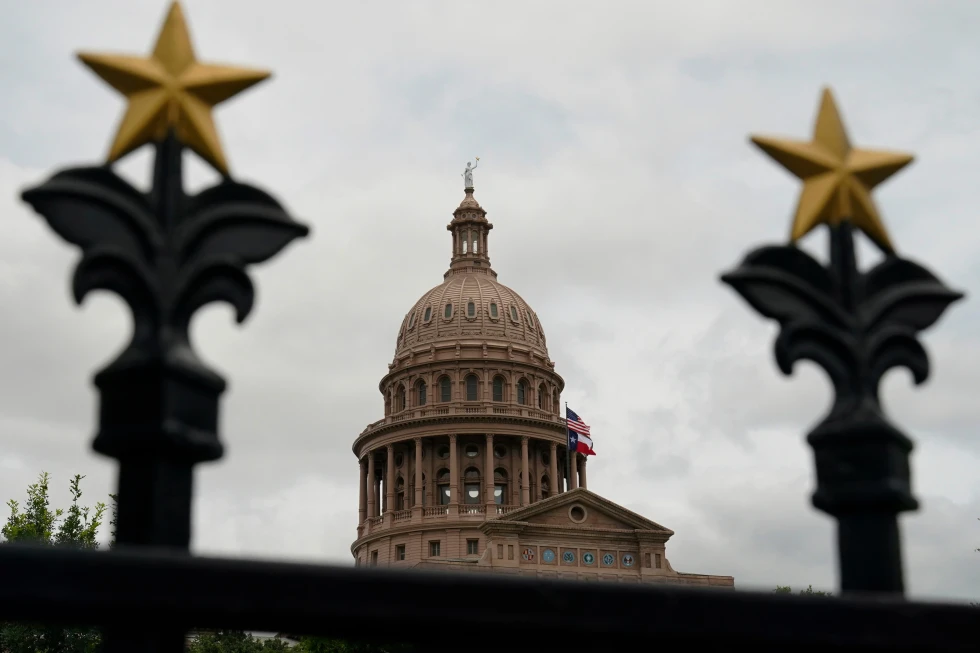
WASHINGTON (AP) — The U.S. Supreme Court on Friday temporarily blocked a lower court ruling that found Texas’ 2026 congressional redistricting plan pushed by President Donald Trump likely discriminates on the basis of race.
The order signed by Justice Samuel Alito will remain in place at least for the next few days while the court considers whether to allow the new map favorable to Republicans to be used in the midterm elections.
The court’s conservative majority has blocked similar lower court rulings because they have come too close to elections.
The order came about an hour after the state called on the high court to intervene to avoid confusion as congressional primary elections approach in March. The justices have blocked past lower-court rulings in congressional redistricting cases, most recently in Alabama and Louisiana, that came several months before elections.
The order was signed by Alito because he is the justice who handles emergency appeals from Texas.
Texas redrew its congressional map in the summer as part of Trump’s efforts to preserve a slim Republican majority in the House in next year’s elections, touching off a nationwide redistricting battle. The new redistricting map was engineered to give Republicans five additional House seats, but a panel of federal judges in El Paso ruled 2-1 Tuesday that the civil rights groups that challenged the map on behalf of Black and Hispanic voters were likely to win their case.
As President Donald Trump laid it out to reporters this summer, the plan was simple.
Republicans, the president said, were “entitled” to five more conservative-leaning U.S. House seats in Texas and additional ones in other red states. The president broke with more than a century of political tradition in directing the GOP to redraw those maps in the middle of the decade to avoid losing control of Congress in next year’s midterms.
Four months later, Trump’s audacious ask looks anything but simple. After a federal court panel struck down Republicans’ new map in Texas on Tuesday, the entire exercise holds the potential to net Democrats more winnable seats in the House instead.
“Trump may have let the genie out of the bottle,” said UCLA law professor Rick Hasen, “but he may not get the wish he’d hoped for.”
Trump’s plan is to bolster his party’s narrow House margin to protect Republicans from losing control of the chamber in next year’s elections. Normally, the president’s party loses seats in the midterms. But his involvement in redistricting is instead becoming an illustration of the limits of presidential power.
The early days of artificial intelligence were defined by competition among large language models like OpenAI’s ChatGPT and Anthropic’s Claude. That phase, however, is largely old news.
Today, investor attention has shifted from who builds the smartest model to the massive scale of capital expenditures, or capex, behind the AI boom. This refers to money companies spend to acquire or upgrade long-term assets such as data centers, servers and networking infrastructure.
Related: Sign up for stock news with our Invested newsletter.
Unlike regular operating expenses, these investments are meant to generate returns over several years. When a company pours money into capex instead of paying dividends or buying back shares, it’s a signal that management believes reinvesting internally will deliver stronger future growth.
Nowhere is this more evident than among the so-called “AI hyperscalers” – massive tech firms building and operating large-scale computing infrastructure to support artificial intelligence workloads. These companies are racing to dominate cloud-based AI services by spending heavily on energy-hungry data centers and specialized chips.
For example, a February research report from J.P. Morgan Asset Management projected that combined capex for four of the “Magnificent Seven” stocks – Microsoft Corp. (ticker: MSFT), Alphabet Inc. (GOOG, GOOGL), Amazon.com Inc. (AMZN) and Meta Platforms Inc. (META) – would reach $318 billion this year alone.
However, capital is largely circulating within a closed loop: hyperscalers buying chips from AI hardware makers, which in turn depend on those same hyperscalers as customers. Meanwhile, actual corporate spending on AI deployments and productivity gains remains uneven.
The question, then, is whether the industry is entering a speculative bubble – one that might painfully deflate once investors realize that the AI industry’s economics are more circular than revolutionary.
Bubbles are easy to recognize in hindsight, but during them, optimism and promises of a new paradigm attract continuous inflows and new highs. For retail investors, this enthusiasm has been most visible in the proliferation of AI-themed exchange-traded funds (ETFs).
For those not interested in picking individual AI stocks, these ETFs offer a hands-off, professionally managed way to invest in the artificial intelligence trend.
Some follow passive index benchmarks focused on AI-enabling technologies, while an increasing number are actively managed, supported by fundamental research and proprietary models aiming to identify the next big winners in the space.
“We believe it is critical to approach investing in generative AI companies with an actively managed approach,” says Thomas DiFazio, ETF strategist at Roundhill Investments. “The AI landscape is rapidly evolving, and it is crucial to be nimble.”
Here are six of the best AI ETFs to buy today: